

Proposition 19 changed how California property taxes on inherited property work, and many families still do not know it. You may have bought the family home decades ago and paid a low property tax bill, and you assume your kids will inherit that low bill along with the house. Since February 16, 2021, that assumption is no longer safe. In many families, the kids’ property tax bill can jump after they inherit, sometimes by thousands of dollars a year.
This guide explains what Prop 19 changed, who still keeps the low property tax base, what is no longer protected, and what to ask while you still have time to plan your California estate.
Does Prop 19 Increase Property Taxes on Inherited Property in California?
It can. It depends on three things: whether the home was your principal residence, whether your child will make it theirs, and how the home’s market value compares to its old assessed value. If all three line up, your child may keep your low property tax base. If any one does not, the home can be reassessed at today’s market value.
Because the rules are specific and the stakes are high, this is a planning question, not something to sort out after a funeral. It is also separate from probate. Even a home that avoids court through a living trust can be reassessed.
How Did Inherited Property Taxes Work in California Before Prop 19?
Under Proposition 13, a California home’s assessed value is set when it is bought and is generally limited in how fast it can rise each year. That is why a home owned for decades can carry a property tax bill far below what a new buyer would pay.
Before Prop 19, children could inherit that low base in a much broader way. According to the California State Board of Equalization (BOE), transfers on or before February 15, 2021 fall under the older rules, Propositions 58 and 193. Under those rules, a parent could also pass up to $1 million of assessed value of other real property, like a rental or second home, to a child without reassessment.
What Did Prop 19 Change for Inherited Homes in California?
Prop 19 applies to transfers on or after February 16, 2021. It made two major changes:
- The family home exclusion is narrower. The exclusion applies to a family home that passes from the parent’s principal residence to the child’s principal residence, or to a family farm.
- The exclusion for other real property is gone. The BOE states that Prop 19 “eliminates exclusion for other real property other than the principal residence.” Rentals, vacation homes, and other properties no longer qualify.
Who Qualifies for the Parent-Child Property Tax Exclusion Under Prop 19?
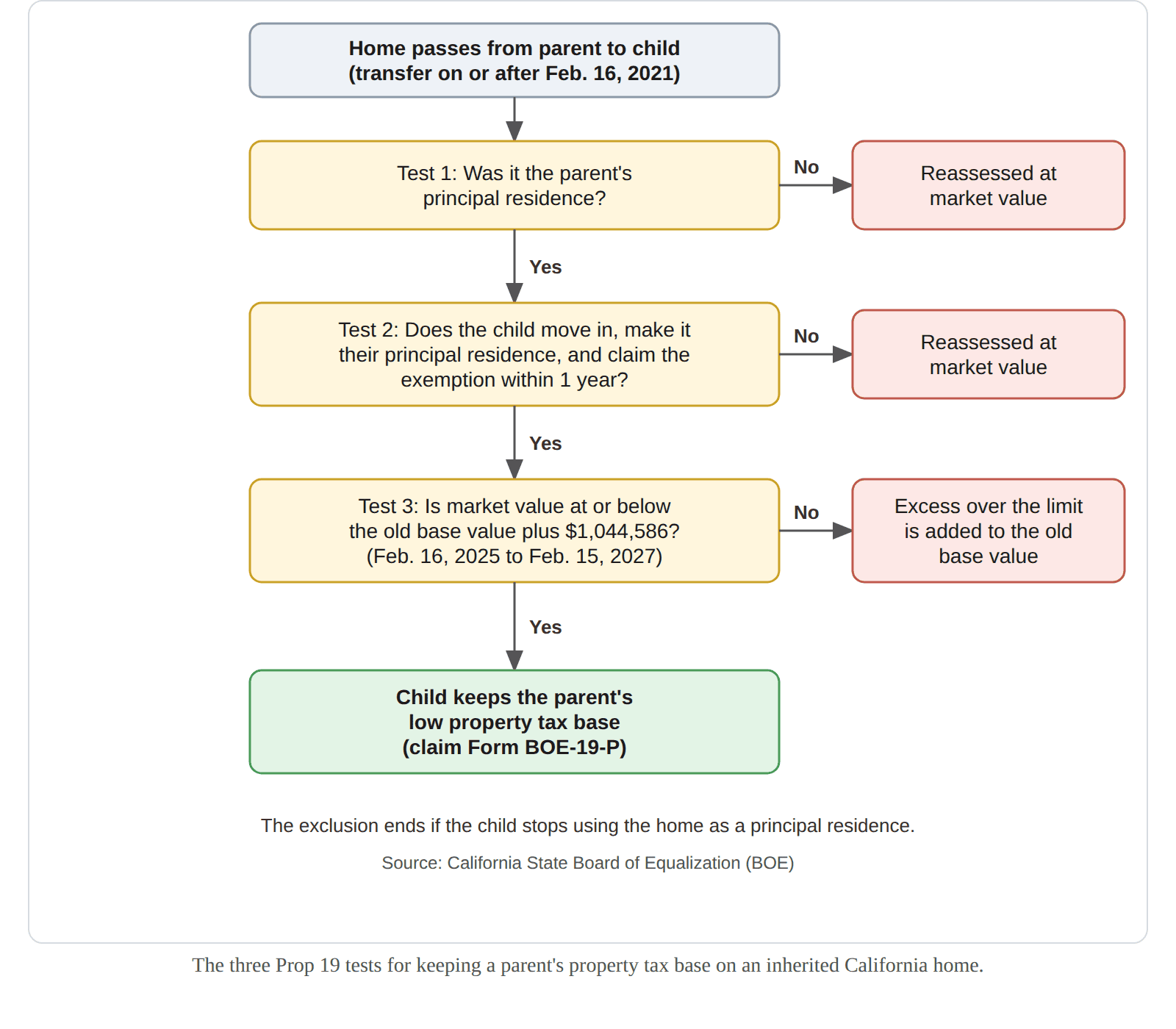
To keep the low assessed value on an inherited home, all of these generally must be true:
- The home was the parent’s principal residence. According to the BOE’s publication on parent-child transfers, the family home “must have been the principal residence of the transferor.”
- The child makes it their principal residence. The child must make it their home and continue living there. The child also needs to claim the homeowners’ or disabled veterans’ exemption within one year of the transfer.
- The value stays under the limit. This is the money test, and we cover it in the next section.
Grandparent-to-grandchild transfers can qualify only if the grandchild’s parent, the grandparent’s child, is deceased on the date of transfer.
How Does the Prop 19 Value Limit Work? The $1 Million Rule Explained.
Even when the home qualifies, there is a cap. The excluded amount is tied to the home’s factored base year value (its old assessed value, adjusted over time) plus $1 million. That million-dollar figure is adjusted every two years. According to the BOE’s announcement of the adjustment, it is $1,044,586 for transfers from February 16, 2025 through February 15, 2027.
If the home’s market value is at or below that limit, the old base value carries over to your child. If the market value is higher, the excess is added to the base value, and your child is taxed on the new, higher number.
Here is a simple example based on the BOE’s own publication, which uses the original $1 million figure. A home with an old assessed value of $300,000 has a limit of $1.3 million. If it is worth $1.5 million when your child inherits it, the $200,000 above the limit is added to the old value, and the new taxable value is $500,000, instead of $1.5 million at market value. Without the exclusion, the taxable value would reset to the full market value.
In today’s California market, many family homes are worth far more than their old assessed value, so this calculation matters for a lot of families.
Which Inherited Properties Are Not Covered by Prop 19?
Prop 19 does not protect everything that used to be covered. These situations are generally outside the exclusion:
- Rental properties. The home has to have been the parent’s main residence, not an investment.
- Vacation or second homes. Only the principal residence qualifies.
- Other real estate. Additional properties passed to children are reassessed.
- Transfers between siblings. According to the BOE publication, sibling-to-sibling transfers are not excluded.
If you own more than one property, this is often where families are surprised. A parent who planned to leave a rental to one child and the home to another may need a different plan today.
What Happens If Your Child Moves Out or Rents the Inherited Home?
The exclusion does not last forever without conditions. The BOE explains that at least one eligible child must continue to live in the property as their family home. If your child later rents the house out, moves away, or stops using it as a principal residence, the exclusion is removed, and the property is reassessed.
The property can then be reassessed at its current market value, which is why a child who plans to keep the home long term should understand this rule before moving.
How Do You Claim the Prop 19 Exclusion? Form BOE-19-P
The claim is not automatic. The BOE publication says the claim, Form BOE-19-P, is filed with the county assessor where the property is located. A few points matter here:
- Timing. The claim must be filed within three years of the transfer date, but before the property is transferred to a third party.
- Late claims. A late claim gives relief only for future years, starting the year the claim is filed.
- The exemption. The child must also file for the homeowners’ or disabled veterans’ exemption.
Deadlines like these are easy to miss during a hard time. If the estate also has to go through court, our guide on how much probate costs in California shows how quickly the costs and tasks add up.
Does a Living Trust Avoid Property Tax Reassessment in California?
This is a common misunderstanding. A living trust is a powerful way to avoid probate, but it does not, by itself, protect the property tax base. What matters for Prop 19 is whether the transfer meets the exclusion rules, not whether the home passes through a trust or a will.
That does not mean a trust is the wrong choice. A properly funded trust still keeps your family out of court. To understand the difference between the two main tools, read our comparison of a trust vs. a will in California, and see our article on how to avoid probate in California.
What Should California Homeowners Ask Before Passing a Home to Their Kids?
Prop 19 does not have one right answer for every family. These questions help shape a plan:
- Who will actually live in the home? If no child plans to move in, the family home exclusion will not apply.
- How much has the home grown in value? The bigger the gap between the old assessed value and today’s market value, the more is at stake.
- Do you own other properties? Rentals and second homes are no longer protected, which can change how you divide your estate.
- How will you treat each child fairly? If one child keeps the home and another receives other assets, the plan has to account for the tax difference.
- Could selling make more sense? Sometimes the family decides to sell, and the tax picture changes.
- Have you talked to a tax professional? An estate attorney and a CPA should look at the plan together, because property tax is only one part of the picture.
Prop 19 Inheritance Rules at a Glance
- Prop 19 applies to transfers on or after February 16, 2021. It narrowed what children can keep when they inherit.
- The family home can still qualify. It must be the parent’s principal residence, and the child must make it theirs.
- There is a value cap. The old base value plus $1,044,586 for transfers from February 16, 2025 through February 15, 2027.
- Other real property is no longer excluded. Rentals and second homes are reassessed.
- The claim is not automatic. File Form BOE-19-P on time.
- A trust alone does not fix this. The transfer has to meet the exclusion rules.
Talk to a California Estate Planning Attorney About Prop 19
If your estate plan was written before 2021, or never considered Prop 19, it may not do what you think it does. The right time to look at it is before your family needs it.
Schedule Your FREE 30-Minute Consultation
Frequently Asked Questions (FAQs)
| Question | Answer |
|---|---|
| Does Prop 19 apply to every inherited home in California? | It applies to transfers between parents and children, and some grandparents and grandchildren, that occur on or after February 16, 2021. Whether your child keeps your low tax base depends on whether the home qualifies as a family home and whether it stays under the value limit. |
| Does my child have to live in the inherited home to avoid higher property taxes? | Yes, to keep the exclusion. The child must make the home their principal residence, claim the homeowners’ or disabled veterans’ exemption within one year, and continue to live there. |
| What is the $1 million rule in Prop 19? | The excluded amount is the home’s factored base year value plus $1 million, adjusted every two years. For transfers from February 16, 2025 through February 15, 2027, the BOE says the adjusted amount is $1,044,586. |
| Are rental properties protected from reassessment under Prop 19? | No. Prop 19 eliminated the exclusion for other real property. Rentals, vacation homes, and other properties passed to children are generally reassessed. |
| Does a living trust protect my kids from a property tax increase in California? | Not by itself. A trust helps avoid probate, but the property tax result depends on whether the transfer meets the Prop 19 rules. |
| How do I claim the Prop 19 parent-child exclusion? | You file Form BOE-19-P with the county assessor where the property is located, within three years of the transfer and before the property is transferred to a third party. |
